
The encyclopedia of Mesozoic life
Dinologue is a field guide to 2,465 species of dinosaurs, pterosaurs and marine reptiles, from 252 to 66 million years ago. Every one is presented like a labelled museum specimen, and everything except the news works offline.
2,465 species · 3,932 fossil sites · 186 million years
Features
Explore
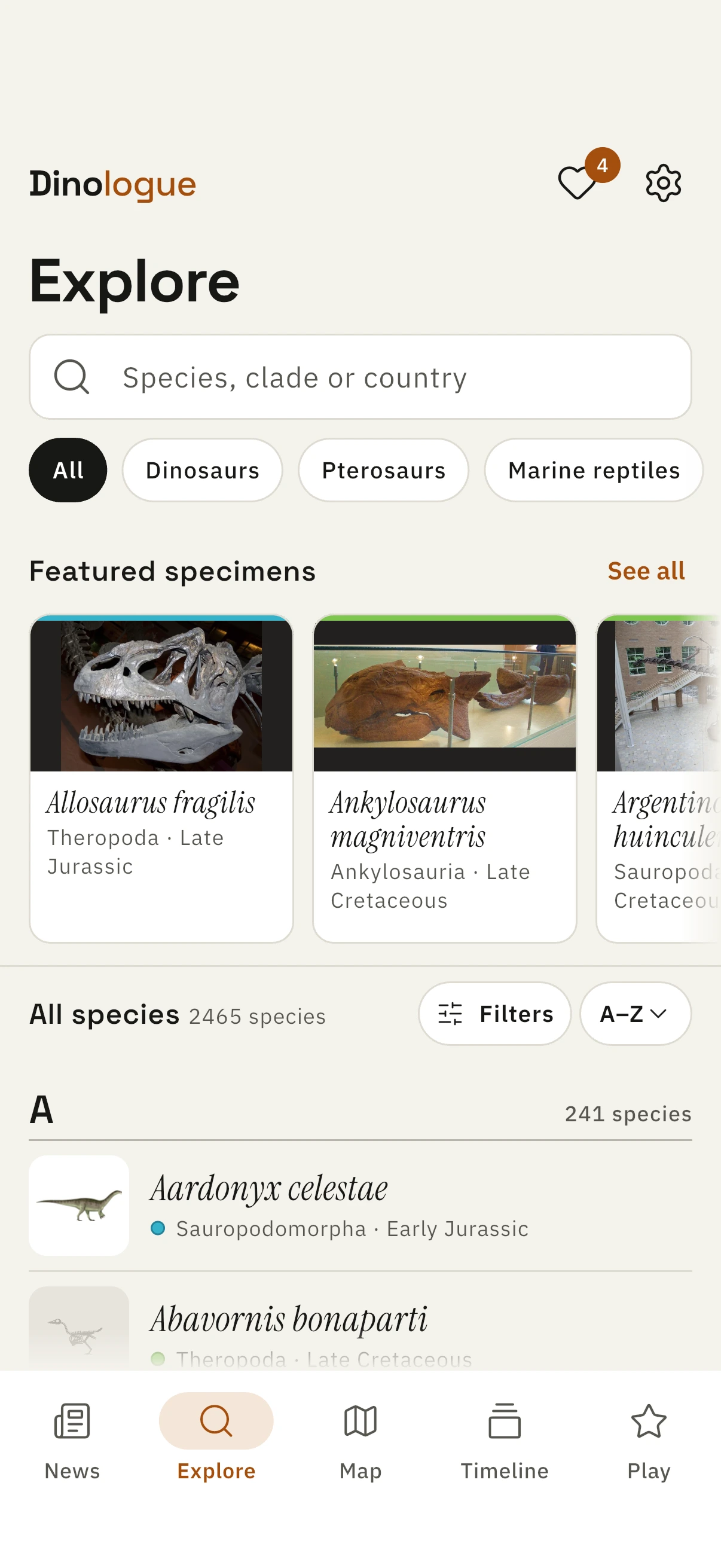
Search all 2,465 species by name. Narrow to dinosaurs, pterosaurs or marine reptiles, filter by subperiod, diet and clade, or start from the 24 featured specimens with hand-written articles.
Species pages
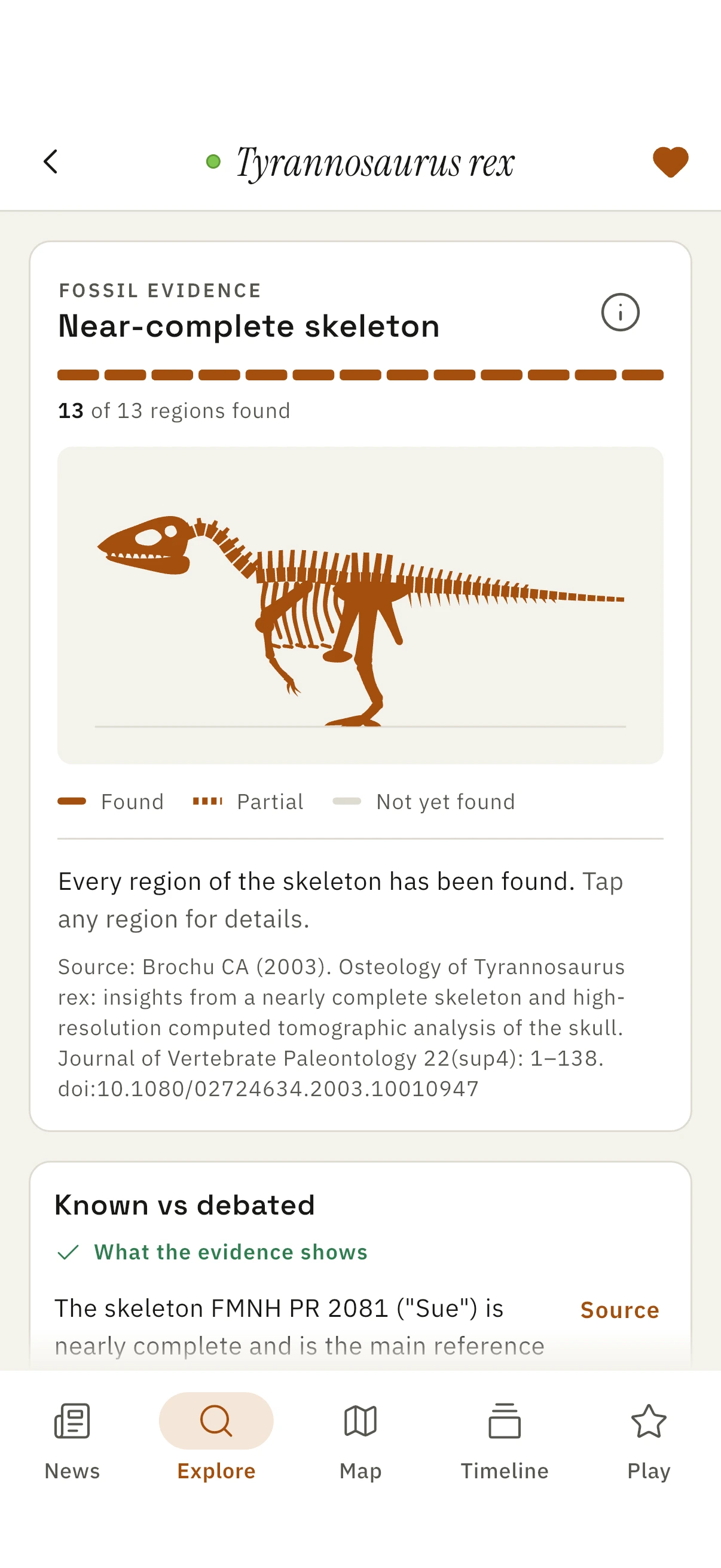
Each species sits in its own display case: the skeleton, a placard with the name, what it means and how to say it, its size beside a person, and an interactive skeleton showing which bones have actually been found.
Fossil map
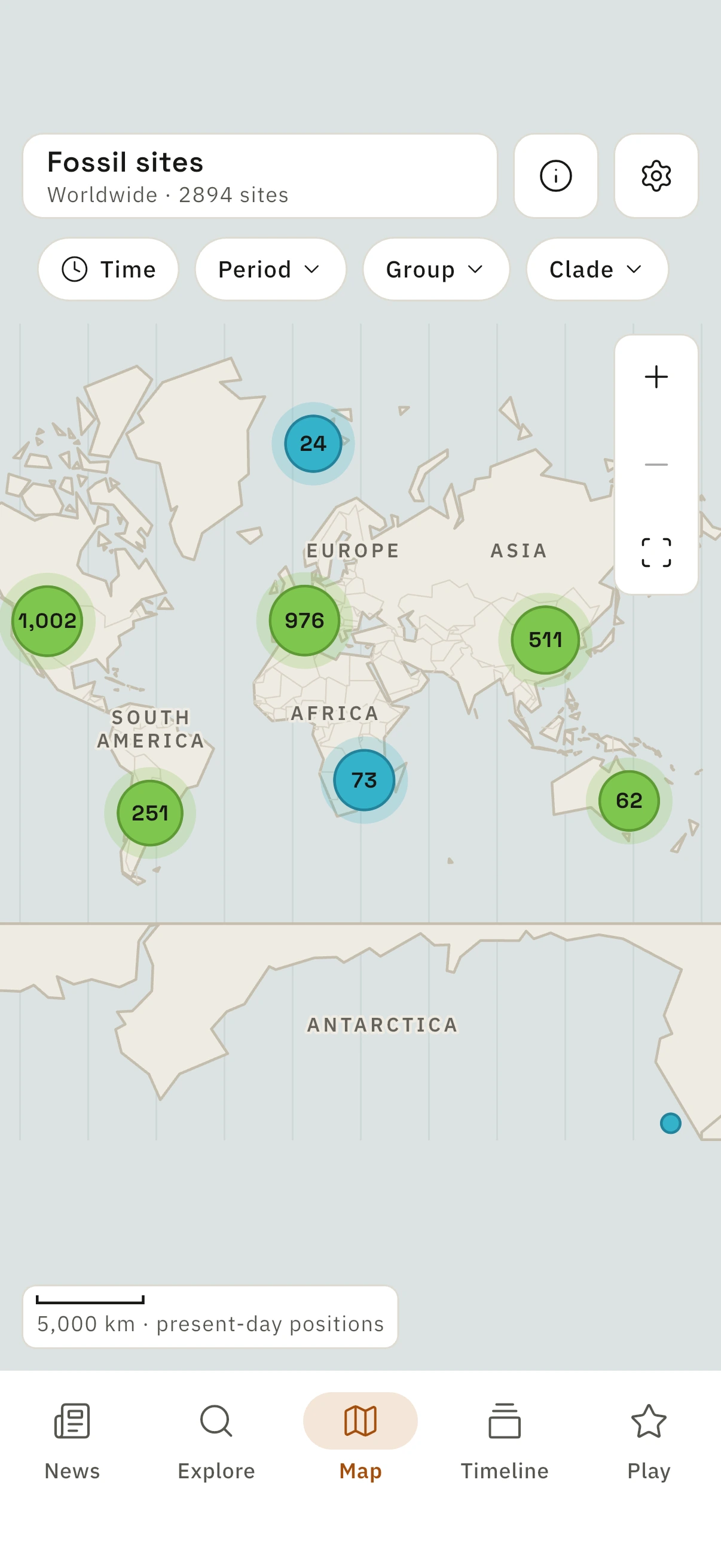
3,932 fossil sites on a map that needs no connection. Scrub from 252 to 66 Ma, or turn on Ancient Earth to see each site where it lay on the planet at the time.
Timeline
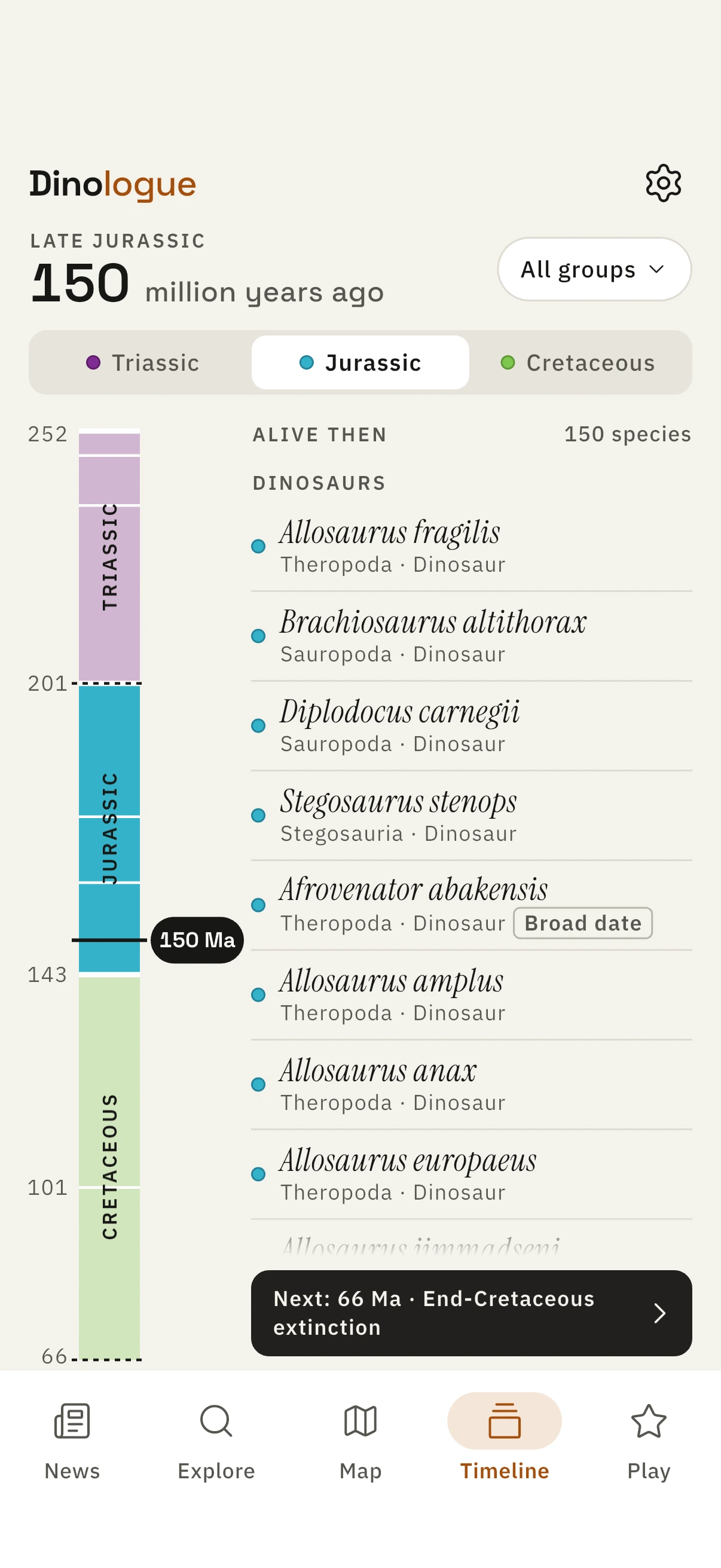
Move through the Mesozoic and see who was alive at any moment. The end-Triassic and end-Cretaceous extinctions each get their own account: who survived, what is still debated, and the sources.
Play
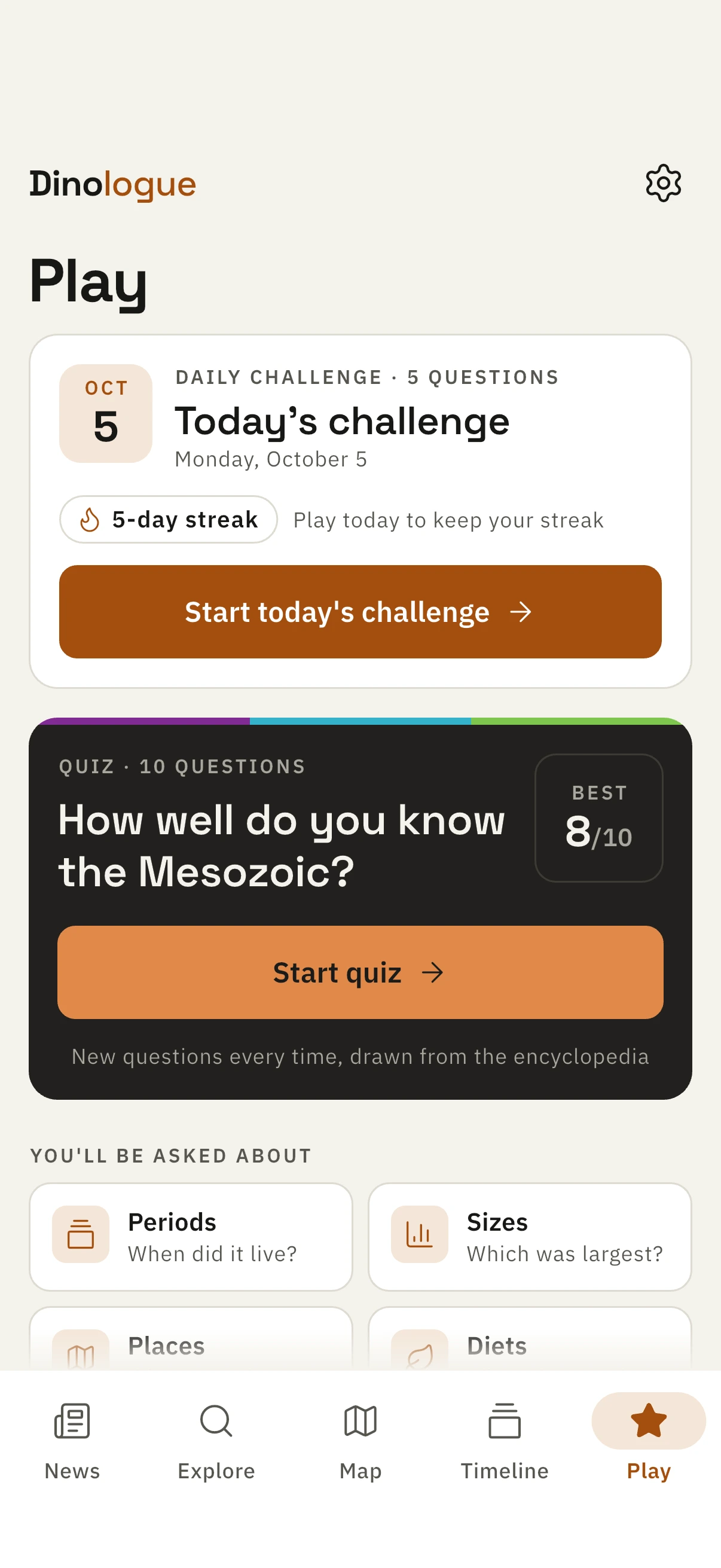
Ten-question quizzes drawn fresh from the encyclopedia across seven kinds of question, from periods and sizes to putting species in order of age. The daily challenge is the same for everyone, and keeps a streak.
News
Paleontology news from a short list of trusted publishers, grouped by day. Duplicate stories are merged, species names link to their pages, and saved stories can be read offline.
Every species, labelled like a specimen.
Dinologue borrows its look from the museum gallery: a dark display case for the skeleton, a placard for the facts, and a clear line between what is known and what is still argued about.
Tyrannosaurus rex — “tyrant lizard king”
One of the largest meat-eating dinosaurs, Tyrannosaurus rex lived in western North America at the very end of the Cretaceous. It is known from dozens of specimens, including some of the most complete large theropod skeletons ever found.
- Lived: 68.4–66.0 Ma · Late Cretaceous
- Length: About 12 m
- Mass: About 8,000 kg
- Diet: Carnivore
- Named: Osborn, 1905
- Fossil record: Near-complete skeleton
- Known: Bone growth rings show that T. rex grew by up to 2.1 kg a day, reached skeletal maturity in about two decades and lived up to about 28 years.
- Debated: A 2022 study proposed splitting Tyrannosaurus into three species, but a reply the same year argued the variation fits a single species, T. rex.
How it works
- Read the specimen. Open any species for its placard: the name and what it means, a pronunciation you can play, its size beside a person, and a skeleton showing which bones are known, partial or missing.
- Find where it was found. Jump to the fossil map to see the sites, then slide back in time. In Ancient Earth mode the continents drift into their old shapes and every site moves with them.
- See who lived alongside it. The timeline lists the species alive at any moment in the Mesozoic, so a single animal becomes a whole community, and the two great extinctions come with their evidence.
- Test what you know. Play a quiz that draws new questions every time, or take the daily challenge: five questions, the same for everyone today.
No accounts. No tracking.
Dinologue has no sign-in, no analytics, no crash reporting and no ads. The encyclopedia, the fossil map and its ancient coastlines, the timeline and the quizzes are all inside the app, so everything except news works in airplane mode, and what you do in the app stays on your phone.
- No account and no sign-in
- No analytics, crash reporting or ad SDKs
- Everything except news works offline
- Favorites, scores and settings stay on your device
Frequently asked questions
Is Dinologue free?
Yes. Dinologue is free to download, with no subscription, no ads and no in-app purchases.
Who is it for?
Curious teens and adults. Dinologue is written for readers aged 12 and up who want the real science: accepted names, dates, sizes and sources, with the open questions marked as open. It is not designed as a children's app.
Does it work offline?
Everything except news does. The first launch takes a moment to prepare the encyclopedia; after that, species pages, the fossil map, the timeline and the quizzes all work without a connection. News needs one to load new stories, and anything you save can be read offline.
Where does the data come from?
Species and fossil sites come from the Paleobiology Database, the research community's shared record of the fossil literature. Ancient coastlines and site positions are reconstructed with the Müller et al. (2019) plate model, and modern map outlines come from Natural Earth. The 24 featured articles are written for Dinologue, with a source cited for every claim.
How accurate is it?
Dinologue reflects the published science as of each content release, and it is careful to separate what is well established from what is still debated. Paleontology moves, though: new fossils and new analyses revise the picture all the time. Treat it as a well-sourced reference for learning, not a substitute for the primary literature.
Where does the news come from?
From a short allowlist of publishers: The Conversation, ScienceDaily, Phys.org, PLOS ONE, Fossil Record and Frontiers in Earth Science. Your phone fetches their public feeds directly. There is no Dinologue server in between, and articles open in an in-app browser on the publisher's own page.
Which devices does it run on?
iPhones on iOS 15 or later and Android phones on Android 7.0 or later.
How do I get in touch?
Email support@maykrware.com. Corrections to the science are especially welcome, with a source if you have one.
Get Dinologue.
Available on the App Store and Google Play. Free to download, with no subscription, no ads and no in-app purchases.
Privacy Policy · Terms & Conditions · support@maykrware.com
Species and fossil site data from the Paleobiology Database (CC BY 4.0). Ancient coastlines and site positions reconstructed with the Müller et al. (2019) plate model (EarthByte Group, University of Sydney; CC BY-SA 4.0) via the GPlates Web Service. Map outlines from Natural Earth (public domain). Space Grotesk, IBM Plex Sans and Instrument Serif are used under the SIL Open Font License 1.1.
Loading Dinologue…